ATV Bolt Patterns Explained
Four numbers decide whether a wheel bolts to your quad. Here is what they mean, why the front and the rear are different, and how to check yours in five minutes.
On this page
Bolt pattern is the first thing that has to be right and the easiest thing to get wrong. Everything else about a wheel — width, offset, whether it clamps the bead — is a tuning decision you can argue about in the pits. Bolt pattern is a yes or a no. Get it wrong and the box sits in your garage until you pay to ship it back.
The good news is that it is simple once somebody explains the notation, and the sport quad world only really uses four patterns. Here is all of it in one place, including the part most guides skip: your quad almost certainly does not use the same pattern front and rear.
What 4/110 actually means
A bolt pattern is written as two numbers. The first is how many studs are on the hub. The second is the diameter, in millimetres, of the imaginary circle those studs sit on — the bolt circle. So 4/110 is four studs on a 110mm circle. 4/144 is four studs on a 144mm circle. Same stud count, bigger circle, completely different wheel.
Because the count is always four on a sport quad, the second number is the one doing all the work. A 34mm difference in bolt circle sounds small written down. On the hub it means the holes do not line up at all, and nothing you do with a longer stud or a thinner nut is going to save it.
Why the front and the rear are different
On a sport quad the front hubs and the rear axle hubs are entirely different parts doing entirely different jobs. The rear is a solid axle carrying drive and most of the load. The front turns, takes braking, and hangs off a spindle. Manufacturers never had a reason to make the two share a bolt circle, so they did not.
That is why RWI drills front wheels 4/144 and 4/156, and rear wheels 4/110 and 4/115 — the numbers published on every race kit and beadlock wheel page. Two patterns per end, so one wheel covers both sides of the brand split instead of forcing you into a make-specific part number.
That brand split is the other half of the story, and it is cleaner than you would expect. Yamaha went one way. Effectively everybody else went the other.
Sport quad bolt patterns by make
| Make | Rear | Front | Machines on RWI’s fitment list |
|---|---|---|---|
| Honda | 4/110 | 4/144 | TRX250EX, TRX250R, TRX300EX, TRX400EX, TRX450R |
| Yamaha | 4/115 | 4/156 | Banshee, Raptor 250, Raptor 350, Raptor 660, Raptor 700, YFZ450, YFZ450R |
| Suzuki | 4/110 | 4/144 | LTR400, LTR450 |
| Kawasaki | 4/110 | 4/144 | KFX400, KFX450 |
| Can-Am | 4/110 | 4/144 | DS450X, DS450MX, DS450XC, DS650 |
Machine lists come from the compatibility block RWI publishes on its wheel and race-kit product pages. KTM (450SX, 505SX, 525XC) and Polaris (Outlaw 450, Outlaw 500, Outlaw 525, Predator 500) sit on that same fitment list — confirm the exact pattern for your machine in the fitment guide before you order.
Read it the practical way. If you ride a YFZ450R, a Raptor 700 or a Banshee, you are on 4/115 at the rear and 4/156 up front. If you ride a TRX450R, an LTR450, a KFX450R or a DS450, you are on 4/110 at the rear and 4/144 up front.
This is also why Yamaha wheels move around the Yamaha paddock so freely. Banshee, Raptor, Warrior and YFZ hubs share the pattern, which is why a set pulled off one machine so often lands on another one two trailers down.
What “dual drilled” means on an RWI wheel
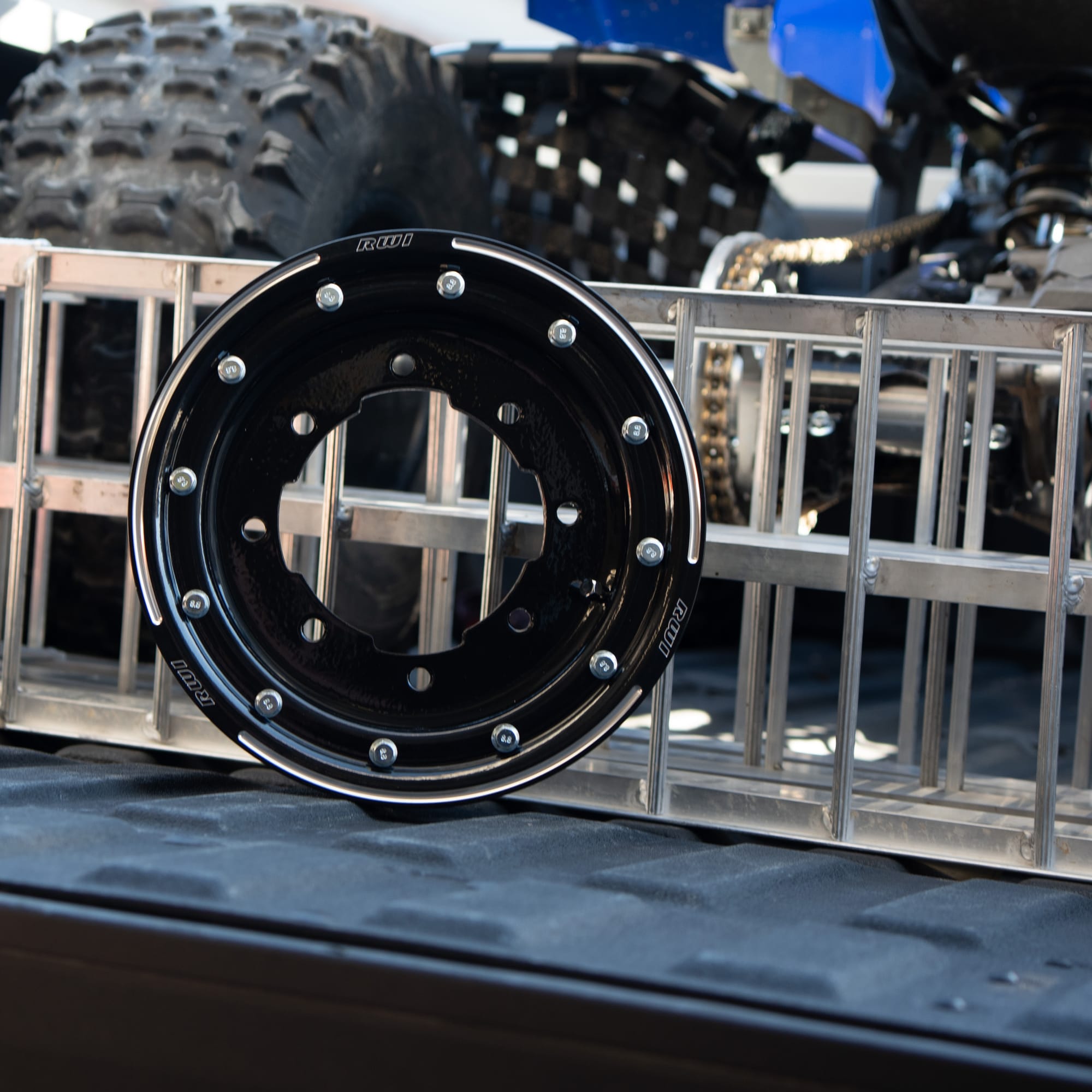
Every RWI wheel is drilled for both patterns at its end of the machine. A rear carries 4/110 and 4/115. A front carries 4/144 and 4/156. You will see eight holes on the mounting face and you will use four of them.
That is deliberate. It means one part number covers the sport quad paddock instead of splitting the catalogue into a dozen make-specific SKUs, and it means the wheels follow you when you change machines. The 9x9 (4+5) double beadlock rear is published as a universal 4/110 and 4/115 fitment for exactly that reason.
How to measure a four-lug hub yourself
You do not need a special tool for this. On a four-stud hub the studs sit directly opposite each other, so the bolt circle is a straight measurement between two of them.
- 01Pull the wheel and clean the hub face, so you are measuring metal instead of mud.
- 02Pick a stud, then find the stud directly across from it — not the one next to it.
- 03Measure centre to centre between those two studs in millimetres. That number is your bolt circle.
- 04Round to the nearest published pattern. Around 110mm is 4/110, around 115mm is 4/115, and so on. Those two are only 5mm apart, so measure twice before you spend anything.
- 05Repeat at the other end of the machine. The front and the rear will not match.
Bolt pattern gets you mounted. It does not get you dialled.
A wheel that bolts on can still be the wrong wheel. Offset decides where the tyre actually sits relative to the hub, and therefore how wide your track is and how much load lands on your wheel bearings — that is ATV wheel offset explained. Diameter and width decide how the tyre behaves and what clears your fenders and A-arms, which is the wheel size guide.
Whether you run a mechanical bead clamp at all is its own decision, and one worth making before you spend rather than after. Beadlock versus rolled lip lays out both sides honestly, including the case for not running one.
If you would rather not read three articles to buy one set of wheels, run your year, make and model through the fitment guide. It returns the bolt pattern and the offset range for your machine, and lists the RWI wheels that match.
Common questions
Count the studs on the hub and measure centre to centre between two studs that sit directly across from each other. Four studs on a 110mm circle is 4/110. Do it at both ends of the machine, because sport quads use a different pattern front and rear. You can also look it up by year, make and model in the RWI fitment guide.
No. They are 5mm apart on the bolt circle and they are not interchangeable. Honda, Suzuki, Kawasaki and Can-Am sport quads use 4/110 at the rear; Yamaha uses 4/115. RWI rear wheels are drilled for both so one wheel covers either hub, but your machine only uses one of the two.
Because the front spindles and the rear axle hubs are different parts with different jobs, and manufacturers never standardised them to each other. On sport quads the fronts are the larger circle — 4/144 or 4/156 — and the rears are the smaller 4/110 or 4/115.
Adapters exist, but they push the wheel outboard, add a second set of fasteners between you and the hub, and change how the load reaches your wheel bearings. On a race machine we would rather sell you a wheel that is already drilled for your hub, which is why RWI wheels carry both patterns at each end.
Often, yes. Because fronts are drilled 4/144 and 4/156 and rears 4/110 and 4/115, a set covers both the Yamaha pattern and the Honda, Suzuki, Kawasaki and Can-Am pattern. Check offset and width against the new machine as well — bolting on is not the same as fitting properly.